
A chance to preserve a special piece of family history, while also achieving premium energy efficiency, were reasons enough for Jesse Low and his brothers to seek out GCE's free energy coaching services. “We built this house when I was 9 years old,”...
By John Stroud
A chance to preserve a special piece of family history, while also achieving premium energy efficiency, were reasons enough for Jesse Low and his brothers to seek out the free energy coaching services offered by Garfield Clean Energy.
“We built this house when I was 9 years old,” Low said of the modest, 1,500-square-foot house near Carbondale that his family built 53 years ago, and which he and his brothers inherited.
“It had gotten to the point where it needed some major work. The roof was leaking, so we knew we at least needed to put a new roof on it,” he said.
As such projects often go, once they started looking at all that really needed to be done – replacing the old single-pane windows, adding insulation where there was essentially none – it quickly became a major rebuild, Low said.
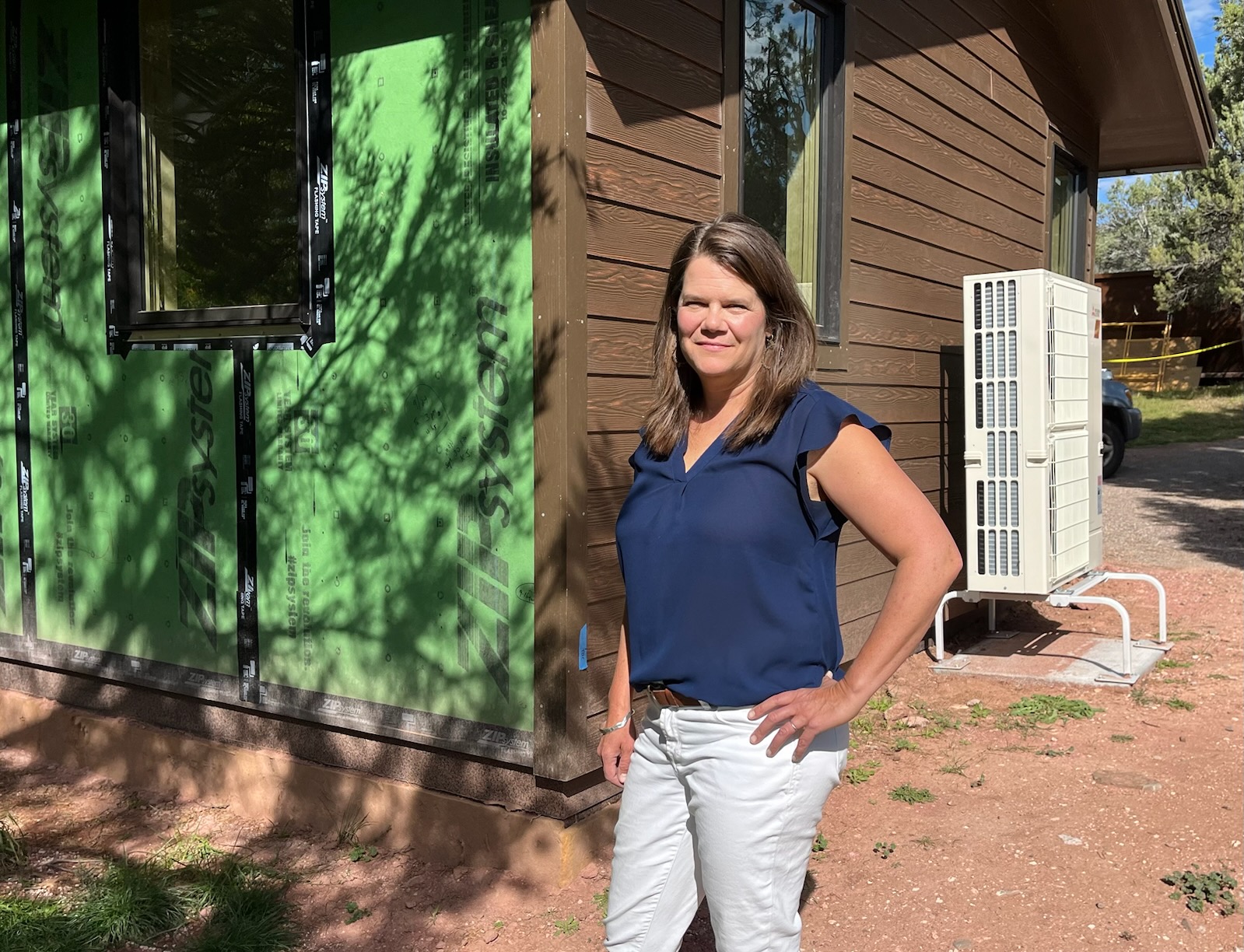
Architect Donna Riley, with the Low home's added insulation and exterior heat pump unit visible behind.
“At that point it becomes a decision, ‘Well, do we just knock it down and start over, or do we rebuild?’” he said. “In this case, there was no question. We love this house, and we wanted to preserve its integrity as much as possible.”
A couple of other values came into play.
Low said he and his brothers have a “sustainability bent,” and that they try to be “good stewards of this beautiful place.”
From his point of view as a park service employee in Australia, where he splits his time part of the year, Low is also fully aware of the wildfire danger in the thick juniper, pinion and scrub oak hills and sagebrush meadows that surround Carbondale.
So, first, they decided to build in a way that the structure would be protected from potential wildfire – clearing a defensible space and using fireproof decking, siding and roofing materials.
Insulation and mechanical systems
Second, through their local architect, Donna Riley, they reached out to Clean Energy Economy for the Region (CLEER) seeking advice on energy efficiency features that could be incorporated into the project. CLEER is the nonprofit that runs GCE’s energy-efficient building, transportation and renewable energy programs.
Riley first met with CLEER Buildings Specialist Heidi McCullough about the project in early 2023.
“This project had its challenges,” Riley said. “We were renovating a house that’s over 50 years old, that had very little insulation, and had some mechanical systems issues.”
Riley worked with McCullough and the Garfield County Building Department on a way to insulate the house by building the walls out, instead of inward, to achieve adequate R value (R16 is the end result). Low said that was important so that none of the existing interior space was pinched down.
When it came to the mechanical systems, Riley turned to McCullough for ideas. The site already had a solar array for electric power generation, so her clients wanted to go all-electric with the rebuild. They had received an estimate of over $100,000 for a cold-climate heat-pump system, but that was not going to fit in their budget.
A heat pump is an appliance that uses electricity to provide both heating and cooling, moving heat in during the winter and out during the summer. Moving heat around is more energy-efficient than creating it.
McCullough referred the Lows to Ron Birkenfeld of Carbondale-based GreenLife Mechanical, who specced a heat-pump system at a fraction of the price.
“He’s someone who has worked with old houses a lot, and takes the time to understand what you’re working with, what can stay, and what can’t,” Low said. The system that Birkenfeld installed was so much less expensive largely because he designed it to utilize the building’s existing ductwork.
“There's just so much waste of perfectly good stuff being ripped out in some of these rebuilds,” Low said. “Being able to make some of that work reduces that waste, and also makes it more affordable.”
Paying off in the long run
McCullough said GCE's energy coaching depends on how detailed or technical a project is. Sometimes the client is simply looking for information about how to take advantage of rebate programs or how to make their home or business more energy efficient. Other times, they’re looking to take advantage of a free building energy assessment through GCE’s ReEnergize Program.
“If it’s more technical, I will sit down with the homeowner and the design team and look at what they’re planning to do and where they can achieve some efficiencies, so that they can decide how to move forward,” McCullough said.
Low said GCE was helpful in pointing him and his team in a direction that will ultimately minimize waste and result in better energy efficiency that will pay off in the long run. He’s still working to see how it all pencils out, and which of the various rebate programs, grants and tax writeoffs he can take advantage of.
“A lot of it is starting with best practices, and then trying to find the best practices you can get at an affordable price,” Low said. An energy consultation with GCE is a way to get there, he said.