
With the birth of their first child on the horizon this past spring, Doug Winter and Bailey Leppek decided their traditional method of summertime home cooling wasn’t going to cut it.
“(One) exterior wall of the house gets up to 120 degrees fahrenheit on a hot summer day; it’s facing due west and it’s getting hot,” Doug said.
A swamp cooler would provide some relief overnight but be short-lived coming morning. By the evening, much of the home felt “sweltering,” Doug said. Combined with the real risk of wildfire smoke exposure on an infant's respiratory system, they decided it was time for an improvement.
“Arguably the bigger factor was smoke,” Doug explained. “When we were realizing in February how low the snowpack was, we felt like this summer had potential to be really bad.”
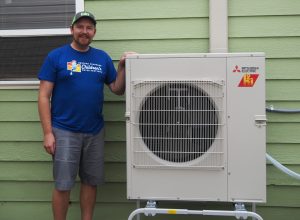
Doug Winter stands next to a new mini-split system at his home in Glenwood Springs.
That’s where Garfield Clean Energy came in. GCE provided a home energy assessment shortly after they first moved into their South Glenwood Springs home in 2018.
“We were looking initially at a mini-split for just one room and then realized through the rebate program that we could actually do the whole house for essentially the same cost,” Doug said.
In place of a swamp cooler and passive cooling, Doug Winter and Bailey Leppek’s home now has a mini-split system that provides both heating and cooling for a more comfortable and consistent home temperature.
In total, their household received $10,100 in rebates, which covered a bit more than half of the project’s overall cost. Rebates came from the City of Glenwood Springs, Community Office for Resource Efficiency (CORE) and Municipal Energy Agency of Nebraska (MEAN), the wholesale electric power provider for Glenwood Springs.
Now their home has a mini-split heating and cooling system that regulates the temperature for the entire home – and it’s made a huge difference.
“It was really a much more moderate temperature (this summer); mid-to-low-70s, just consistently, throughout the day,” he said.
The project itself went fast, but Doug said anyone considering a similar project should factor in some patience for the permitting process to play out.
“The total time for install was probably select days over the course of a week, so probably a few working days or so,” he said. “It was really smooth. We had a newborn kid in the house during installation, and they were really respectful of our space.”
Another piece of advice Doug offered is to start with a home energy assessment before diving into a mini-split installation. Doing so means you’ll have an easier time knowing your home is well-sealed, insulated and ready to make the most of a mini-split.
“A home energy assessment is logically a very good step because you’ll find things that can be addressed before you get a mini-split for much less money that may also be covered by rebates,” he said. “Always look to the home energy assessment as a means to identify the least-intensive project — get the low-hanging fruit first.”
To learn more about heat pumps and home energy assessments, sign up for free energy coaching at Garfield Clean Energy.